View the full Strategic Plan
About the Plan
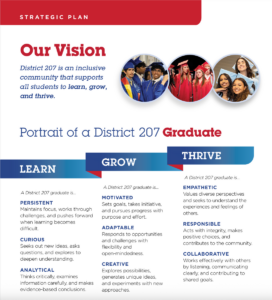
 We are proud to share District 207’s Strategic Plan for 2026-2030 — a roadmap that belongs to all of us. This plan is the result of a 12-month process during the 2025-26 school year that engaged thousands of students, families, staff, and community members across our district. The work you contributed — through surveys, focus groups, and planning sessions — shaped every goal, every strategy, and the vision at the heart of this document: that District 207 is an inclusive community that supports all students to Learn, Grow, and Thrive. View the full strategic plan.
Centered on a Portrait of a Graduate — defining the persistent, curious, analytical, motivated, adaptable, creative, empathetic, responsible, and collaborative young people we are committed to developing — the plan is organized around four goals: Learning, Access, Connections, and Communications. During the summer of 2026, teams across the district will be working to establish specific, measurable targets for each goal and strategy, which will be shared via a public dashboard this fall. We encourage you to read the plan and bring your questions forward through our email dedicated to strategic planning: [email protected].
Strategic Plan Goals:
Goal 1: LEARNING
Engage all students in enriching, rigorous, and relevant LEARNING.
A. Collaborate with educators to establish clear, shared definitions and expectations for rigorous, relevant, and consistent instruction through district-wide curriculum and instructional frameworks in alignment to the Portrait of a Graduate goals.
B. Provide teachers with professional learning to support and align resources to deliver high-quality core curriculum and instruction that is accessible and challenging for all students.
C. Provide staff with data to guide instruction, inform curriculum, monitor equity, and support continuous improvement.
Goal 2: ACCESS
Ensure ACCESS and opportunity for all students.
A. Build consistent district-wide early intervention systems to identify student needs using shared criteria across schools and provide timely, targeted support along with core instruction.
B. Strengthen programming to provide coherent and sustainable high-quality services that expand access to rigorous learning, reduce unnecessarily restrictive placements, and stretch student learning.
C. Partner with students and families so they understand available programs, course options, supports, and how student progress is monitored and adjusted over time.
Goal 3: CONNECTIONS
Build CONNECTIONS so every student feels known, valued, and prepared for post-graduation success.
A. Design consistent, relationship-based systems that promote strong adult and student relationships that affirm student identity and promote inclusive school cultures.
B. Strengthen comprehensive advising systems that provide culturally responsive guidance, personalized support, future planning, and meaningful connections throughout each student’s educational journey.
C. Increase district-wide attendance to provide students with a deeper sense of belonging, higher academic achievement, social connection, and long-term success.
Goal 4: COMMUNICATIONS
Provide clear COMMUNICATIONS and ongoing engagement with district stakeholders.
A. Establish clear expectations for roles, responsibilities, policies, and practices across the district.
B. Build more proactive and transparent systems for communication and engagement to strengthen stakeholder trust.
C. Strengthen data access, quality, and transparency to support shared understanding for all stakeholders and inform decision-making.